

Parents who want their kids to excel in STEM through games, toys and coding and robotics classes in Bay Area and develop strong critical thinking skills know that not all screen time is created equal. But recent brain imaging research is giving us a clearer picture of how excessive or passive screen time might affect young brains
Drawing from the NIH's largest-ever brain study of American children, plus new MRI data from Singapore and Cincinnati, this post breaks down what the scans actually show, what the evidence does and doesn't prove, and what practical steps families can take. No alarmism — just the research, clearly translated.
👉 Read Part 2- What Denmark Knows About Your Child's Brain That Your School District Isn't Telling You
👉 Take control of your child's digital safety by reading our deep dive into Roblox's 130+ filed lawsuits
Understanding MRI Findings on Screen Time
Cortical Thinning in 9–10 Year Olds
MRI scans are like high-tech windows into the brain, showing us structural changes that could impact development. One of the biggest ongoing projects is the NIH's Adolescent Brain Cognitive Development (ABCD) Study, tracking over 11,000 U.S. kids since 2017.
In 2025 updates, researchers found that 9-10-year-olds logging 7+ hours of daily screen time often show premature thinning in the cerebral cortex—the outer layer handling higher-order thinking, problem-solving, planning, and emotional regulation.
This cortical thinning is a process that normally unfolds during adolescence. When neuroimaging data suggests it appearing earlier, researchers have linked it in follow-up studies to weaker attention and impulse control. A 2025 longitudinal analysis from the ABCD data, published in Translational Psychiatry, associated reduced cortical thickness in the left superior frontal gyrus specifically with rising ADHD symptoms over two years and differences in working memory.
Important context: These are associations observed in population-level neuroimaging data. The studies do not establish that screen time directly causes these structural differences — other factors, including sleep quality, socioeconomic environment, and content type, are all part of the picture. Researchers are careful to say the findings warrant attention, not alarm.
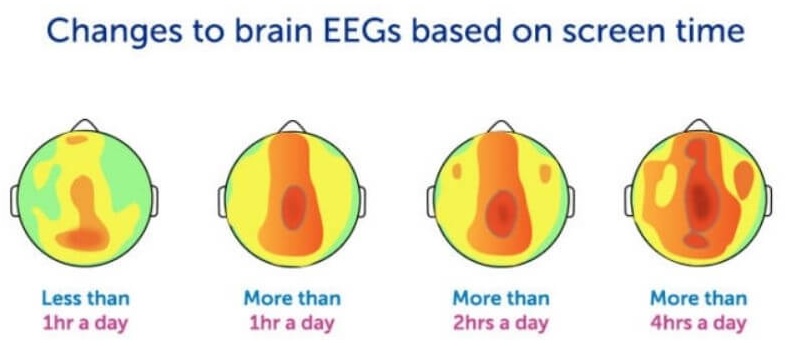
What Happens to a Child's Brain After 7–10 Hours of Daily Screen Time?
This is the question researchers at the NIH set out to answer when they began tracking thousands of children's brains using MRI in 2017. Here is what the evidence shows so far.
According to neuroimaging data from the NIH ABCD Study, children who regularly exceed 7 hours of daily screen time show signs of earlier-than-typical cortical thinning and differences in white matter development compared to peers with lower screen use. These structural differences have been associated in follow-up studies with attention difficulties and challenges with emotional regulation. Researchers describe these as associations — the data shows a relationship, not a proven chain of cause and effect.
At 9–10 hours daily, the patterns are more pronounced. The 2025 Translational Psychiatry analysis found that children in the highest screen-use groups showed the most notable cortical thinning in prefrontal regions — the areas most associated with focus, planning, and impulse control. Two-year follow-up data showed these children had higher rates of emerging ADHD symptoms.
U.S. children currently average 7.5–8 hours of daily screen time when entertainment and school screens are combined — which means many kids are regularly in the range where these associations appear in the research.
What Matter and Younger Children
Even younger children show measurable differences in neuroimaging studies.
The Cincinnati Children's Hospital study (2019, with 2024-2025 follow-ups) scanned 3-5-year-olds and revealed that those exceeding 1 hour of daily screen time had lower white matter integrity—the "highways" connecting brain regions for language, literacy, and cognition.
Lead researcher Dr. John Hutton explains: "White matter develops in direct proportion to how much it's used. Tracks involved with language get thicker and more myelinated." Passive screen viewing — content that flows without requiring the child to respond, create, or interact — appears to engage these pathways less than conversation, play, or reading aloud.
A 2025 follow-up study built on this earlier research, finding altered amygdala responses in high-screen toddlers that were associated with elevated anxiety risk by adolescence.
What Singapore's GUSTO Study Revealed
These findings are not limited to U.S. research.
Singapore's GUSTO cohort study, published in December 2025 in eBioMedicine, followed 168 children from infancy using MRI scans at ages 4.5, 6, and 7.5. Children with high screen exposure before age 2 showed brain maturation patterns associated with slower decision-making and higher anxiety by age 13. Asst. Prof. Tan Ai Peng of A*STAR noted: "Infant screen exposure appears to alter brain network integration, potentially through disrupted sleep and reduced real-world interaction."
A separate 2025 Singapore neuroimaging study of teenagers found associations between heavy scrolling behavior and reduced prefrontal gray matter, pointing to possible differences in regions linked to:
Impulse control
Teens in high-screen groups showed patterns associated with more impulsive responses and difficulty resisting immediate rewards.
Emotional regulation
A July 2025 study from Nanyang Technological University (NTU) linked prolonged social media use to behaviors associated with a dopamine-driven feedback loop — reinforcing constant novelty-seeking.
Long-term outcomes
The GUSTO data associated these early patterns with slower decision-making and higher anxiety by age 13.
The Impact on the Resting Brain and Sleep
The Default Mode Network
Cortical thinning is the most headline-ready finding, but there are subtler effects worth understanding. One involves the default mode network (DMN) — the brain's "idle" state, which activates during daydreaming, creative thinking, empathy, and self-reflection. This network is not passive in any meaningful sense; it's doing important developmental work.
When screens fill every moment of downtime, children lose the "productive boredom" that builds this network. A 2025 ABCD follow-up study found that heavy screen use was associated with DMN disruptions that resembled ADHD symptoms, including poor emotion regulation. Dr. Peng Huang, a neuroscientist affiliated with the Singapore research, noted: "Excessive screen time impairs information integration in the default mode network, potentially eroding resilience."
Sleep, Blue Light, and Brain Development
Sleep is where much of the brain's consolidation and repair happens — and screens disrupt it in a specific, measurable way. Blue-spectrum light from screens suppresses melatonin production, pushing the body's sleep timing later.
A 2025 BBRF-funded study linked childhood screen time to shorter sleep duration, which in turn was associated with white matter differences and elevated rates of depression by age 13. For children under 5, this window is especially critical: brains are at peak plasticity, wiring pathways for language, emotional regulation, and social skills.
The 2026 AAP guidance update reflects this complexity, moving away from rigid hour-based limits toward an emphasis on quality and context — with a firm recommendation of no solo screen use before 18 months (video calls with a known adult are an exception).
Practical Tips for Parents: Spot Risks and Build Better Habits
Not All Screen Time Is Equal
The neuroimaging studies consistently show milder associations for interactive, educational screen use than for passive video consumption. Co-viewing — watching content together and discussing it — has been linked to language pathway benefits in some MRI studies, likely because the adult interaction adds the conversational layer the brain needs.
If your child uses educational tools and AI activities, or attends coding and robotics programs, the screen time involved looks neurologically different from the same time spent scrolling a social feed. The consistent distinction in the research is passive consumption versus active engagement.

Early Warning Signs to Watch For
You don't need an MRI to notice the early behavioral signals researchers associate with heavy screen use: shorter attention spans away from screens, reduced interest in unstructured or imaginative play, and emotional dysregulation — particularly around screen limits or removal.
If you notice these, it's worth auditing the content and context of screen time before the total hours. AAP guidelines recommend no screens before 18 months (except video calls), and a maximum of 1 hour of quality content daily for ages 2–5. For school-age children, the emphasis is on balance, co-viewing where possible, and consistent tech-free windows.
Building Healthier Habits at Home
The most useful thing the research communicates is that brains are highly adaptable. The structural differences observed in MRI studies are not permanent outcomes — multiple studies have documented improvements when screen habits change.
Dr. Dinesh Sivakolundu notes: "Screens redirect natural drives toward consumption," but the same neuroplasticity that makes children responsive to heavy screen habits also means those habits can be reshaped with intention.
Practical starting points that don't require a complete overhaul:
- Designate tech-free zones — mealtimes and the hour before bed tend to have the highest impact.
- Model the behavior you want. Children in the 8–12 age range are especially attuned to what parents actually do versus what they say.
- Replace passive screen time with something active and creative. Hands-on AI projects and STEM camps give screen-age kids something to make rather than just consume.
- Use the Curious Kids Calendar for weekend alternatives, or browse free museum days in the Bay Area for low-cost, screen-free options.
The science here is not a verdict. It's a set of findings that warrant attention, and the families who use it well are the ones who make one or two concrete changes rather than trying to overhaul everything at once.

For parents, this means early habits matter—U.S. kids average 7.5-8 hours daily, often crossing thresholds where these changes emerge.
The Policy Response: What Countries Are Doing With This Research
European governments aren't restricting screens because they distrust technology. Denmark — one of the most tech-forward economies in the OECD — is also one of the most aggressive on youth screen limits. The reason is precisely because they take neurological development seriously.
The Brain Science Meets PolicyWant to understand what governments are actually doing with this research — and what it means for your child's school?👉 Read Part 2: What Denmark Knows About Your Child's Brain That Your School District Isn't Telling You →
Questions Parents Ask
What happens to a child's brain after 7–10 hours of daily screen time?
According to the NIH ABCD Study, children ages 9–10 in the heaviest screen-use groups show signs of premature thinning in the cerebral cortex — the brain's outer layer responsible for planning, focus, and emotional regulation. This thinning normally occurs during adolescence. When associated with heavy early screen use, it has been linked in two-year follow-up data to rising ADHD symptoms and working memory differences. A 2025 analysis in Translational Psychiatry found these patterns most pronounced in the left superior frontal gyrus. These are associations from neuroimaging data, not proof of direct causation.
What is cortical thinning and should parents be worried?
Cortical thinning is a reduction in the thickness of the brain's outer layer. Some thinning is a normal and healthy part of adolescent brain development — it reflects the brain becoming more efficient. What researchers note is that in children with heavy passive screen use, this process may appear earlier than expected, before underlying networks have fully developed. Current evidence shows associations with attention and emotional regulation, but brains are highly adaptive. Early neuroimaging differences do not automatically predict permanent outcomes, especially when habits change.
At what age does screen time have the biggest impact on brain development?
Two periods stand out in the research. The first is under age 2, when the brain grows fastest and depends most on real-world interaction to build language and social-emotional pathways. Singapore's GUSTO cohort study found that high screen exposure before age 2 was associated with altered brain network development and higher anxiety by adolescence. The second sensitive window is ages 3–5, where the Cincinnati Children's Hospital study found measurable differences in white matter integrity in children exceeding 1 hour of daily screen time.
Is all screen time equally harmful to a child's brain?
No — and this distinction matters practically. Passive, entertainment-based screen time is consistently associated with stronger negative effects in neuroimaging studies than interactive or educational use. Co-viewing — watching together with a parent and discussing the content — has been linked to language pathway benefits in some studies. The 2026 American Academy of Pediatrics guidance reflects this: rather than strict hour limits, it emphasizes quality, context, and avoiding passive solo use, especially before age 18 months.





%20(300%20x%20250%20px)%20(1).avif)
%20(300%20x%20250%20px)%20(2)%202.avif)





-min.avif)