

Bay Area parents are still preparing kids for a world that is quietly disappearing. Here's what the data says — and what it actually means for how we raise our children.
For the past two decades, many Bay Area families have followed a version of the same plan. Get your child into rigorous schools early. Stack AP classes. Build the extracurriculars. Aim for Stanford, Berkeley, or at minimum a school with a name that signals something. Then the tech job, the salary, the security.
It was a reasonable plan. For a long time, it worked.
But a growing number of parents — quietly, in conversations at school pickup and at dinner tables — are starting to sense that something has shifted. That the formula they've been optimizing for may no longer be the formula that determines who actually thrives.
They're not wrong to feel that. The data bears it out. And more importantly, so does the deeper logic of what AI is doing to the economy right now.
Academic excellence still matters. But many parents are starting to suspect it may no longer be enough on its own.
What the numbers say about new graduates right now
Let's look at what's actually happening to young people entering the workforce in 2026 — not to alarm, but to understand.
The Job Market Reality: The unemployment rate for recent college graduates (ages 22–27) sits at 5.7%, noticeably outstripping the general U.S. unemployment average of 4.3%.
The Underemployment Trap: Underemployment for recent grads hovers near 41–42%, with specific late-career humanities and general tech entry cohorts spiking as high as 9.7%. (Source: New York Federal Reserve).
Source: NY Federal Reserve, early 2026 data
That statistic tells one story. But the more important question for any parent isn't the unemployment rate itself — it's why. Three forces are colliding at once: AI tools are absorbing many of the routine tasks that used to form the entry-level on-ramp (writing drafts, basic coding, data formatting, customer research). Companies are hiring more cautiously, with leaner teams and higher bars for junior roles. And there are now more graduates than ever, each holding a credential that has become less differentiating precisely because it's so widespread.
The diploma hasn't lost its value entirely. But it has lost its power as a guarantee.
Stanford vs. SJSU — and what the comparison is really about
Here's where the Bay Area conversation gets interesting. Because the data on these two schools tells a more complicated story than most parents expect.
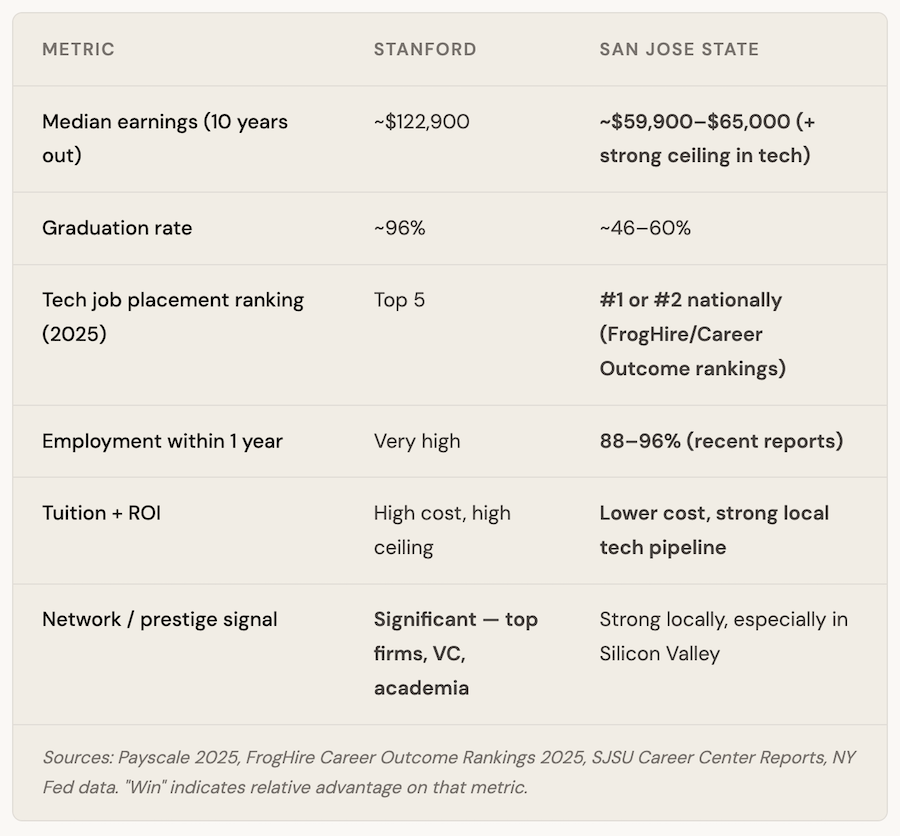
Stanford's advantages are real and shouldn't be dismissed. The long-term earnings premium is significant. The network matters, especially for roles in finance, venture capital, consulting, or graduate academia. If your child gets in and the economics work, it's genuinely valuable.
But here's what the data is also saying: SJSU — a state school that most Bay Area parents treat as a fallback — ranks ahead of Stanford in tech job placement outcomes.
Through geographic proximity, integrated internship pipelines, and highly practical, hands-on coursework, state school graduates land at top-tier tech firms at staggering rates. They frequently hold the exact same engineering roles, at the same companies, as their Ivy-league peers—and often navigate there with zero tuition debt.
Stanford represents the peak of optimized achievement and institutional signaling. SJSU represents the baseline of practical adaptability, execution, and raw proximity to the ecosystem.
In an automated economy, the gap between these two models is closing. The critical differentiator is no longer which school name is printed on the resume. It’s what the student actually built while they were there.
The Shift No One Is Talking About
A machine can easily outperform the most disciplined human student at clean execution. If a task relies on strict rule-following, memory retrieval, or template synthesis, it can be automated for pennies.
The competitive advantage has shifted entirely away from optimized performance and toward adaptive building.
[Traditional Student Model] -> Trains for Clean Execution -> Easily Automated by AI
[Future-Ready Student Model] -> Trains for Adaptive Building -> Highly Replaceable Human Advantage
The human traits that corporate algorithms cannot replicate are the exact skills that determine long-term career resilience:
Emotional Recalibration:
Shrugging off a systemic failure without losing cognitive momentum.
Navigating Ambiguity:
Operating productively when there is no step-by-step instruction manual available.
Systemic Debugging:
Looking at a broken layout, isolating variables, and executing a quick pivot.
Taste and Judgment:
Knowing how and why to direct an AI tool to achieve an original, human-centric outcome.
Think of Serena Williams’ tennis career. Her dominance wasn't defined by hitting mathematically perfect strokes every single match. It was defined by her uncanny psychological durability. When her initial strategy failed, she didn't panic mid-match. She absorbed the setback, analyzed the opponent's shift, restructured her execution, and adapted on the fly.
That Novak-level grit is exactly what separates the next generation of engineers, designers, and innovators from people who are simply good at passing tests.
What Future-Readiness Looks Like at Home
This skill gap doesn't magically form during college. It forms during childhood—in the subtle ways a child is allowed to experience failure, frustration, and problem-solving long before they ever fill out a university application.
To build a child who commands technology rather than one who passively consumes it, look for opportunities to foster these six core habits:
Unassisted Debugging:
Allowing your child to sit with a broken toy, a glitching app, or a tough problem without rushing in to fix it for them.
Open-Ended Iteration:
Supporting projects that have no "correct" answer key—where the process of building, breaking, defending, and modifying is the goal.
Visible Setback Recovery:
Normalizing the reality that early versions of a design will fail, and treating that failure purely as a fresh data point.
Imperfect Communication:
Encouraging kids to pitch or explain their half-finished ideas out loud before they feel fully confident.
AI Command vs. AI Dependency:
Teaching them to critically evaluate, audit, and challenge an AI's output, rather than treating a chatbot like an automated answer machine.
Strategic Anticipation:
Playing games and puzzles that actively reward thinking two to three moves ahead inside a changing system.
Four Actionable Pivots for Parents
1. Shift the Focus of Your Praise
Praise the execution process rather than the final score. Saying, "I noticed how you completely rewrote your approach after that first build collapsed," builds an identity centered around resilience. Saying, "You're so smart for getting an A," inadvertently builds a fragile child who fears risking their perfect record.
2. Create Low-Stakes Friction
Do not smooth every bump on their path. Create intentional household challenges—a complex physical puzzle with missing instructions, a broken family gadget to diagnose together, or a building challenge with strictly limited materials. Let them practice navigating the micro-frustration of being stuck.
3. Build a Project Portfolio Before High School
The student who walks into an interview with a physical or digital portfolio showing three real things they designed, broke, debugged, and can articulate has an undeniable advantage over a student who only brings a pristine transcript of standardized test scores. Start early. A hands-on tinkering or robotics project at age 10 builds the foundational cognitive pathways that an AP class at 16 simply cannot replicate.
4. Audit AI Interactivity
If your child uses adaptive AI platforms or homework tools, set a firm boundary: AI is a collaborative brainstorming partner, not an oracle. If they use a tool to unpack a complex concept, their work isn’t finished when the screen says "Correct." They must close the device and explain the underlying mechanical logic to you in their own human words.
The Bottom Line
The Stanford name will always open elite doors. The SJSU pipeline will continue to funnel elite technical talent straight into the heart of Silicon Valley tech giants. The college diploma is not dead.
But the gap between being highly credentialed and being truly adaptable is widening by the day.
The children who will dominate the future economy are the ones who learn early that ambiguity is manageable, that failure is temporary data, and that the ability to guide your own critical thinking is the most valuable asset you can possess.
That is something no institutional brand name can give them—and no algorithm can take away.
Build the skills that actually last,, stay in touch and personalized your preference now.

Derivatives & startup experience across 3 continents, including China. Elementary school mom to one very active kid. LSE MSc.



%20(300%20x%20250%20px)%20(1).avif)
%20(300%20x%20250%20px)%20(2)%202.avif)
-min.avif)