


Skip the worksheets. Turn household objects into high-leverage logic puzzles that teach systems thinking and debugging.
If you want your kids to develop real-world engineering and strategic thinking skills over a break, standard logic puzzles won't cut it.
Most "educational games" market themselves as critical thinking tools, but they actually just train kids to click buttons for a quick dopamine hit. In 2026, the ultimate competitive advantage isn't knowing how to navigate a pre-made app. It’s knowing how systems work, how to debug an error, and how to command technology rather than just consume it.
Instead of fighting screen time, use these five high-leverage, zero-cost games to turn your living room into an incubation lab. No academic jargon—just pure, high-density problem solving. Remember to read till the end so you know wherey ou can visit
1. The "Broken Rule" Board Game
Don’t buy a new game—hack an old one. Take a basic, classic game you already own and tell your child: "We are going to change exactly one core rule, and we have to playtest it to see if the system breaks."
- The Setup: Use a standard deck of cards, Uno,Connect Four, Jenga, or Checkers.
- The Rule Variant: "What happens to Connect Four if you are allowed to move one piece sideways once per match?"
- What it builds: Systems thinking, loophole detection, and balance mechanics.
- The Real Value: This is basic game loop optimization and software engineering. Kids learn to anticipate logical consequences and see exactly how altering a single variable cascades through an entire system.
2. Reverse-Engineer the Prompt
Instead of letting your kid passively browse an AI image generator, turn it into a high-stakes design challenge. Generate an intentionally unusual image yourself using Line, chatgpt, or Canva and challenge your child to figure out how to recreate it.
- The Setup: Any smartphone, tablet, or laptop running a free image generator (like Line, Chatgpt, Canva).
- The Mechanics: Show them your generated image (like a "neon punk squirrel riding a skateboard on Mars"). Give them five attempts to refine their text descriptions to see who can get closest to the original image layout.
- What it builds: High-precision communication, vocabulary mapping, and prompt literacy.
- The Real Value: They stop treating generative technology like a magic trick. They learn that machines require highly explicit instructions to execute a creative vision perfectly.
3. The Household Constraint Sprint
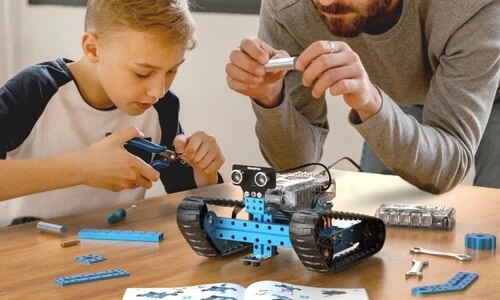
Give your child a random pile of clutter from around the house and issue a specific engineering challenge with rigid limitations. Do not give them an instruction manual.
- The Setup: Gather cardboard boxes, plastic cups, rubber bands, old magazines, or LEGO blocks.
- The Challenge: "Build a bridge spanning the two-foot gap between these two chairs that can support a heavy can of soup. You have 15 minutes, and you cannot use tape."
- What it builds: Physical reasoning, spatial structural logic, and stress-testing under a clock.
- The Real Value: They will almost certainly fail on their first few attempts. The goal isn't a flawless structure; the goal is practicing resilience—sitting with the frustration of a collapsed bridge, identifying the stress fracture, and modifying the design without quitting.
4. The Loophole Debate
Pick a completely ridiculous premise using everyday objects and force your child to defend it using structured logic.
- The Challenge Questions: "Prove to me why a coffee mug should legally be classified as a bowl." Or: "Defend why shoes should be banned inside vehicles."
- The Play: They must present three distinct, logical arguments to back up their claim. You play the role of a strict judge, actively looking for contradictions or weak links in their defense.
- What it builds: Consequence analysis, rhetorical structural logic, and identifying cognitive bias.
- The Real Value: It trains kids to look past surface opinions, stress-test claims against parameters, and realize that every complex human argument involves system trade-offs.
5. Live-Action Household Debugging
The next time a minor household item, toy, or simple appliance stops working properly, do not fix it behind closed doors while your child watches a screen. Bring them into the workspace, lay out the components, and walk through a diagnostic protocol together.
- The Setup: The next time the Wi-Fi drops, a toy stops working, a gadget jams, or a simple household appliance acts up.
- The Diagnostic Framework: Avoid guessing wildly. Ask them:
- What is the exact symptom?
- What was the last state where it functioned perfectly?
- How do we isolate the single broken variable?
- What it builds: Systematic debugging and deductive reasoning.
- The Real Value: Most modern consumer experiences completely mask friction, which leaves kids feeling paralyzed when things break. Teaching them to systematically isolate a single variable to locate a root failure is the foundational mindset of data scientists and engineers alike.
🎁 Local Bonus: The "Berkeley Hills" KEVA Challenge
If you have ever taken your kids up to the Lawrence Hall of Science in the Berkeley Hills, you’ve likely lost two hours of your life watching them sit on the carpet in the engineering room, completely obsessed with those simple, unbranded pine wooden blocks.
If you are in South Bay or SF, visit our
Those are KEVA planks. They have no glue, no connectors, and no snaps—they are perfectly uniform pieces of wood held together entirely by gravity, friction, and balance. They are the ultimate physical sandbox for young structural engineers.
- The Setup: A bulk box of KEVA planks (or standard wooden tumbling blocks) spread out on a hard floor.
- The Challenge: Do not let them just build a standard tower. Give them a structural optimization goal: "Build a cantilevered structure that extends at least six inches past the edge of the coffee table without tipping over. You cannot weight the back down with heavy objects—only other planks."
- What it builds: Counter-weight calculus, center-of-mass visualization, and physical precision.
- The Real Value: KEVA blocks punish rushed work. If a child's hand shakes or their alignment is off by two millimeters, the entire system collapses. It forces them to slow down, build a stable structural foundation, and treat physical forces like code constraints that cannot be cheated.
The goal of these exercises isn't to create hyper-optimized resume-builders. It’s to ensure that when your kids encounter a complex, broken system in the real world, their first instinct isn't to look for an instruction manual—it's to start testing solutions.
Take the Learning on the Road
If your kids loved these living-room engineering sprints and you want to scale up the friction next weekend, the Bay Area is packed with world-class maker spaces, kinetic labs, and open workshops that ditch the manuals entirely.
Explore our curated guide to the best hands-on STEM weekends in the Bay Area.




%20(300%20x%20250%20px)%20(1).avif)
%20(300%20x%20250%20px)%20(2)%202.avif)






-min.avif)